
Generators
Installing a Whole-House Generator Before Winter in New Hampshire: Timeline, Cost Factors, and What's Involved
Published 8 min readBy Copp Electric
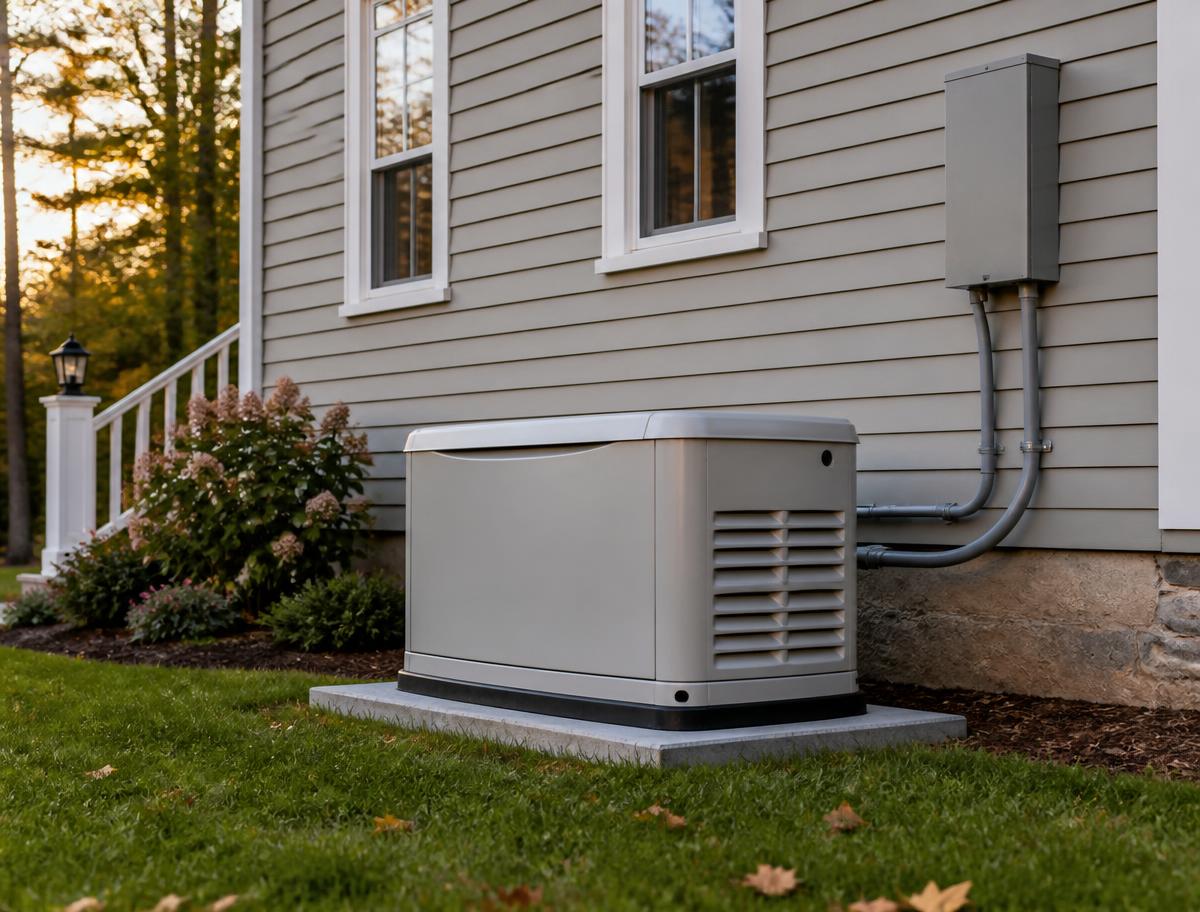
Installing a whole-house standby generator means sizing the unit, setting a pad, adding an automatic transfer switch, connecting propane or natural gas, permitting and inspection, then startup and load testing. Booking in late summer means the unit is commissioned and proven before New Hampshire's outage season starts.
Key takeaways
- Late summer and early fall is the window: the ground is workable, schedules are open, and the unit gets tested before the first ice storm.
- A standby install is electrical plus fuel plus permitting — a transfer switch, panel work, a gas or propane connection, an inspection, and a commissioning load test.
- Cost is driven by size in kW, whole-house versus essential circuits, fuel type, distance from the panel and meter, trenching, and whether the existing panel can carry it.
- On a well, no power means no water — which is why sizing conversations here start with the pump, the heat, and the septic.
- Every install should end with a documented startup, an exercise schedule, and an annual service plan; Copp Electric's basic annual plan is $350.
Why late summer is the right time to install
A standby generator is not an appliance you drop in place on a Saturday. There is a site survey, a load calculation, equipment to order, a permit to pull, a fuel connection to make, an inspection to pass, and a startup to perform. Each of those steps has its own calendar, and they run in sequence.
Start that sequence in late summer and everything has room. Start it after the first storm knocks power out across the Lakes Region and you are in line behind everyone else who had the same idea on the same night — with frozen ground, short daylight, and inspectors booked out.
There is a practical reason too: the value of a standby unit is not the day it gets set, it is the day it starts on its own with nobody home. That takes a commissioning test and at least one exercise cycle to confirm. You want those behind you before the weather is the thing testing it.
What a whole-house generator installation actually includes
The scope is wider than most homeowners expect, because a standby generator ties into two systems at once — your electrical service and your fuel supply.
- Site survey — placement for clearances, exhaust, noise, snow load, and code distances from windows and openings
- Load calculation and sizing — what the unit has to carry, and what it will be asked to start at the same moment
- Pad or composite base set and leveled
- Automatic transfer switch installed — whole-service or a managed subpanel of essential circuits
- Electrical work at the panel, plus conduit and conductors between the unit, switch, and panel
- Fuel connection — propane tank sizing and regulator, or a natural gas line sized for the added demand
- Permit and municipal electrical inspection
- Startup and commissioning — fluid check, transfer test under load, voltage and frequency verified, controller configured
- Exercise schedule set and the operating walkthrough with you
The inspection is not a formality worth skipping. A transfer switch is the device that keeps your generator from backfeeding the utility line a crew is working on — it gets inspected for a reason.
What determines the cost of a generator installation
There is no honest single price for a whole-house generator, and any number quoted before someone has looked at your panel and your fuel supply is a guess. What we can do is tell you exactly what moves the number, so nothing on the quote is a surprise.
| Factor | Why it moves the number |
|---|---|
| Size in kW | Bigger loads need a bigger unit; air-cooled and liquid-cooled are different classes of equipment |
| Whole house vs essential circuits | Backing up everything costs more than a managed set of critical circuits |
| Fuel type | Natural gas needs a line sized for the load; propane may need a larger tank or a second one |
| Distance from the panel and meter | More conduit, more conductors, and possibly trenching |
| Trenching and site access | Ledge, driveways, landscaping, and long runs all add labor |
| Existing panel condition | An older or full panel may need a service or panel upgrade before it can carry a transfer switch |
| Transfer switch type | Service-rated whole-house switches cost more than a load-managed subpanel |
| Permit and inspection | A line item, and non-negotiable |
You get a written quote after the survey, with the equipment, the electrical scope, the fuel work, and the permit spelled out separately. If your panel needs work first, we tell you before you buy a generator, not after.
Whole house or essential circuits? How to decide
Backing up the whole house is the simplest thing to live with — nothing to think about during an outage, nothing to ration. It also means a larger unit and, usually, a service-rated transfer switch.
The alternative is a managed set of essential circuits, which in New Hampshire almost always means: the well pump, the heating system and its circulators, the refrigerator and freezer, the septic pump if you have one, a handful of lights and outlets, and the internet equipment. That list keeps a house habitable through a multi-day outage on a smaller unit.
The deciding question is usually the well. If the pump is on the generator, you have water, heat, and a working bathroom. If it is not, you have lights and a cold shower you cannot take. That is why the load conversation starts there and works outward.
The timeline, step by step
| Stage | What happens |
|---|---|
| Site survey | Placement, load calculation, fuel supply and panel assessed |
| Written quote | Equipment, electrical scope, fuel work, permit, and any panel work itemized |
| Equipment and permit | Unit ordered and the electrical permit pulled |
| Install | Pad set, unit placed, transfer switch and panel work, conduit and conductors run |
| Fuel connection | Propane or natural gas connected and pressure verified |
| Inspection | Municipal electrical inspection |
| Startup and testing | Commissioning, transfer test under load, controller and exercise schedule set |
The stages that are not in our hands — equipment availability, the town's inspection calendar, and fuel supplier scheduling — are exactly the ones that stretch in October and November. That is the case for starting now.
Why New Hampshire homes need this more than most
Outages here are not brief and they are not rare. Ice loads and wind take down limbs onto rural single-phase lines, and restoration on a back road happens after the main roads are clear — which can mean days, not hours.
Add what a New Hampshire house depends on electricity for: a well pump for all water, a boiler or furnace with electric controls and circulators, and in many homes a septic pump. Lose power in January and the failure mode is not inconvenience, it is frozen pipes and a house you cannot stay in.
That is also why propane matters here. Plenty of properties have no natural gas at the street, so the fuel plan is part of the install — tank size, regulator, and run length all have to support the unit at full load, not just at idle.
What happens after the install
A generator earns its keep only if it is maintained. Once the unit is commissioned it runs a weekly exercise cycle on its own, and it needs an annual service visit — oil and filters, spark plugs, battery, gas line, voltage readings, and an operational test, all recorded on a written report.
Copp Electric's basic annual service plan is $350 and covers an 18-point checklist, with every reading compared against the previous year's report so wear shows up as a trend instead of a breakdown. Our technicians are factory-trained on Generac, which is what most standby units in this area are.
We work across Franklin, Tilton, Northfield, Belmont, Laconia, Concord, Sanbornton, Boscawen, plus Bristol, Center Harbor, Gilford, Loudon, Meredith, Moultonborough, and New London.
Getting on the schedule before winter
The first step is a site survey — someone standing at your panel and your fuel supply, running the load numbers, and telling you what the job actually is. From there you get a written quote with nothing hidden in it.
If you want the generator working and proven before the first outage of the season, late summer is when that conversation should happen. Call and we will get the survey booked.