
EV Chargers
What EV Charger Installation Costs in New Hampshire
Published 7 min readBy Copp Electric
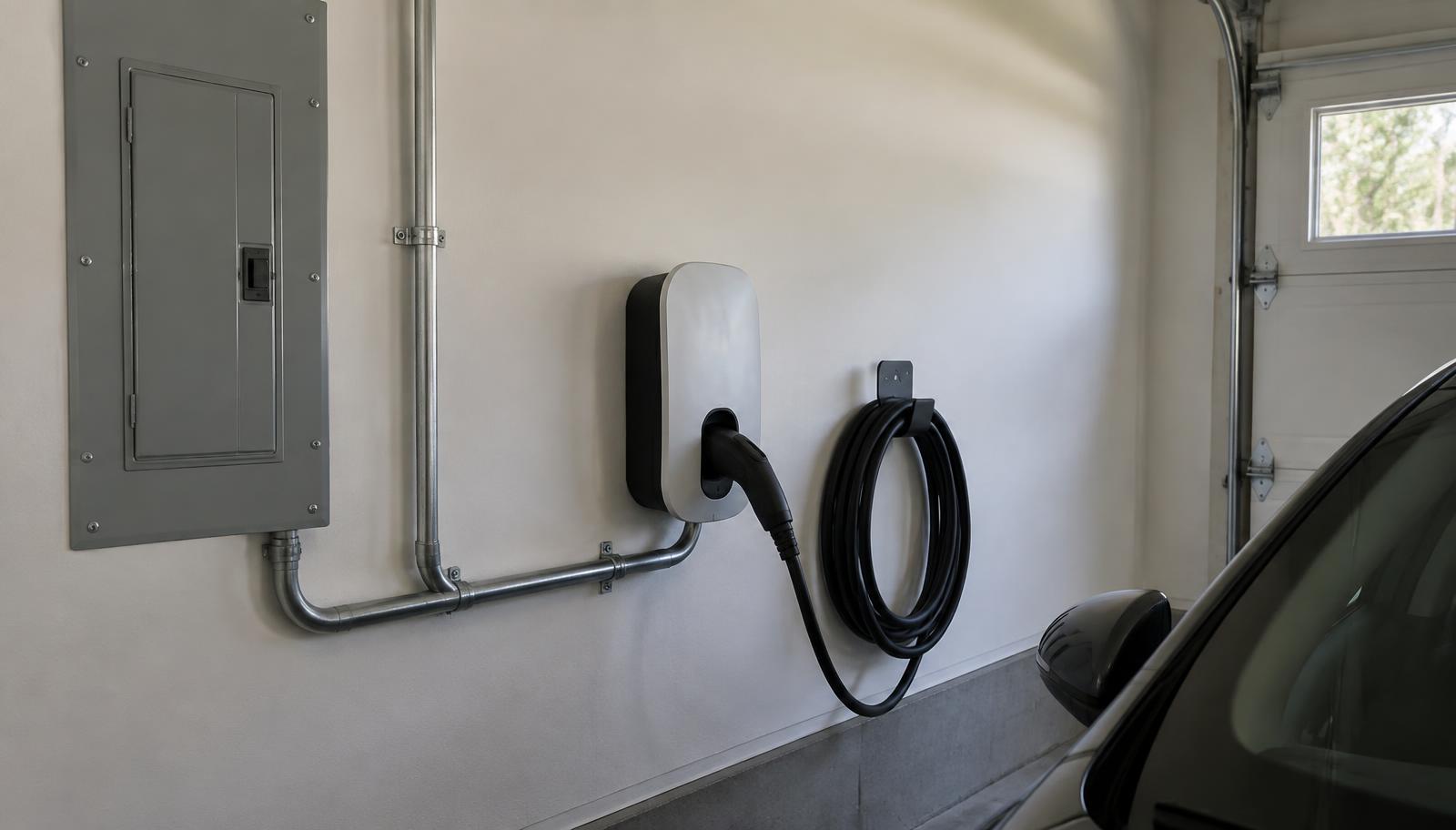
A level 2 home EV charger needs a dedicated 240 volt circuit, and the install cost is driven mostly by how far the charger sits from the panel and whether the panel has capacity for it. A short garage run beside the panel is the simple case. A detached garage, a finished wall, or a full service upgrade is what makes one quote much higher than another.
Key takeaways
- The charger itself is the predictable part. The wiring, the distance, and the panel are what actually set the price.
- A level 2 charger is a dedicated 240 volt circuit, usually 40 to 60 amps, and it needs real capacity left in the panel.
- Hardwired installs are the better choice outdoors and at higher amperage; a plug in unit makes sense when you may move it.
- Detached garages mean a feeder and often a trench, which is the biggest single jump in cost.
- Cold weather reduces range and slows charging, which is exactly why a proper level 2 circuit matters more in New Hampshire than in a warm climate.
Level 1 versus level 2, honestly
Level 1 is the cord that came with the car plugged into an ordinary outlet. It adds roughly three to five miles of range an hour. For a short commute and an overnight window it is genuinely enough, and it costs nothing to install.
Level 2 runs on a dedicated 240 volt circuit and adds roughly 20 to 40 miles of range an hour depending on the charger and the car. That is the difference between a full charge overnight and a car that never quite catches up.
In New Hampshire the case for level 2 is stronger than the numbers suggest, because cold cuts usable range and the car also spends energy conditioning its own battery. A slow charger in February has less headroom than the same charger in June.
What drives the installed cost
Distance is first. A charger mounted on the other side of the wall from the panel is a short run of cable. A charger at the far end of the house, through a finished wall, or out to a detached garage is a different job.
Panel capacity is second. A 40 or 60 amp circuit has to fit both physically and electrically. If the panel is full, or the load calculation says the service cannot carry it, the charger comes with a panel or service conversation attached.
Third is the environment. Outdoor and unheated installs need weather rated equipment and proper conduit, and a garage install has to keep the cable and the unit out of the way of an actual car.
| Situation | What it adds |
|---|---|
| Charger next to the panel | Short dedicated circuit, simplest case |
| Across an unfinished basement or garage | Longer run, still open access |
| Through finished walls | Fishing wire, patching, or a surface raceway |
| Panel full but service adequate | Subpanel or breaker reconfiguration |
| Service at its limit | 200 amp service upgrade before the charger |
| Detached garage | Feeder, often a trench and an underground run |
| Two chargers or future second car | Load management or a larger feeder now instead of twice |
Hardwired or plug in
A plug in charger uses a 240 volt receptacle, typically a NEMA 14-50. It is easy to swap or take with you, and it is the right pick for a renter or for someone who expects to change units.
Hardwiring is the better long term install. It allows higher continuous amperage, removes the plug as a failure point, and is the appropriate choice for anything outdoors or in an unheated space.
Either way it is a dedicated circuit with the correct breaker and the correct conductor size for continuous load. Sharing a circuit with anything else is not an option.
Bring the charger model to the quote if you have already chosen one. Its continuous current rating sets the breaker and the wire size, and that is most of the material cost.
Permits, inspection, and utility programs
A new 240 volt circuit is permitted work in New Hampshire and it gets inspected. That inspection is also what protects you, because a charger is one of the heaviest continuous loads in a house.
New Hampshire utilities have offered EV charging programs and off peak rate options, and those change from year to year. Check what your own utility currently offers before you buy, since some programs have equipment or metering requirements that are easier to meet at installation time than afterward.
We file the permit, meet the inspector, and leave you the labeled circuit and the paperwork, which is what any rebate or program claim will ask for.
Plan for the second car now
The most common regret is a single charger installed at minimum capacity. A second EV arrives, and the cheap run has to be done again.
If a second car is even possible, the moves that cost little now are a larger feeder, a subpanel in the garage, or a charger that supports load sharing. All three are far cheaper before the wall closes and the driveway is poured.
The same is true for a generator. If a standby unit is in your plans, sizing the service once for both is one permit and one shutdown instead of two.
We work across Franklin, Tilton, Northfield, Belmont, Laconia, Concord, Sanbornton, Boscawen, plus Bristol, Center Harbor, Gilford, Loudon, Meredith, Moultonborough, and New London.