
Panel Upgrades
What a 200 Amp Panel Upgrade Costs in New Hampshire
Published 7 min readBy Copp Electric
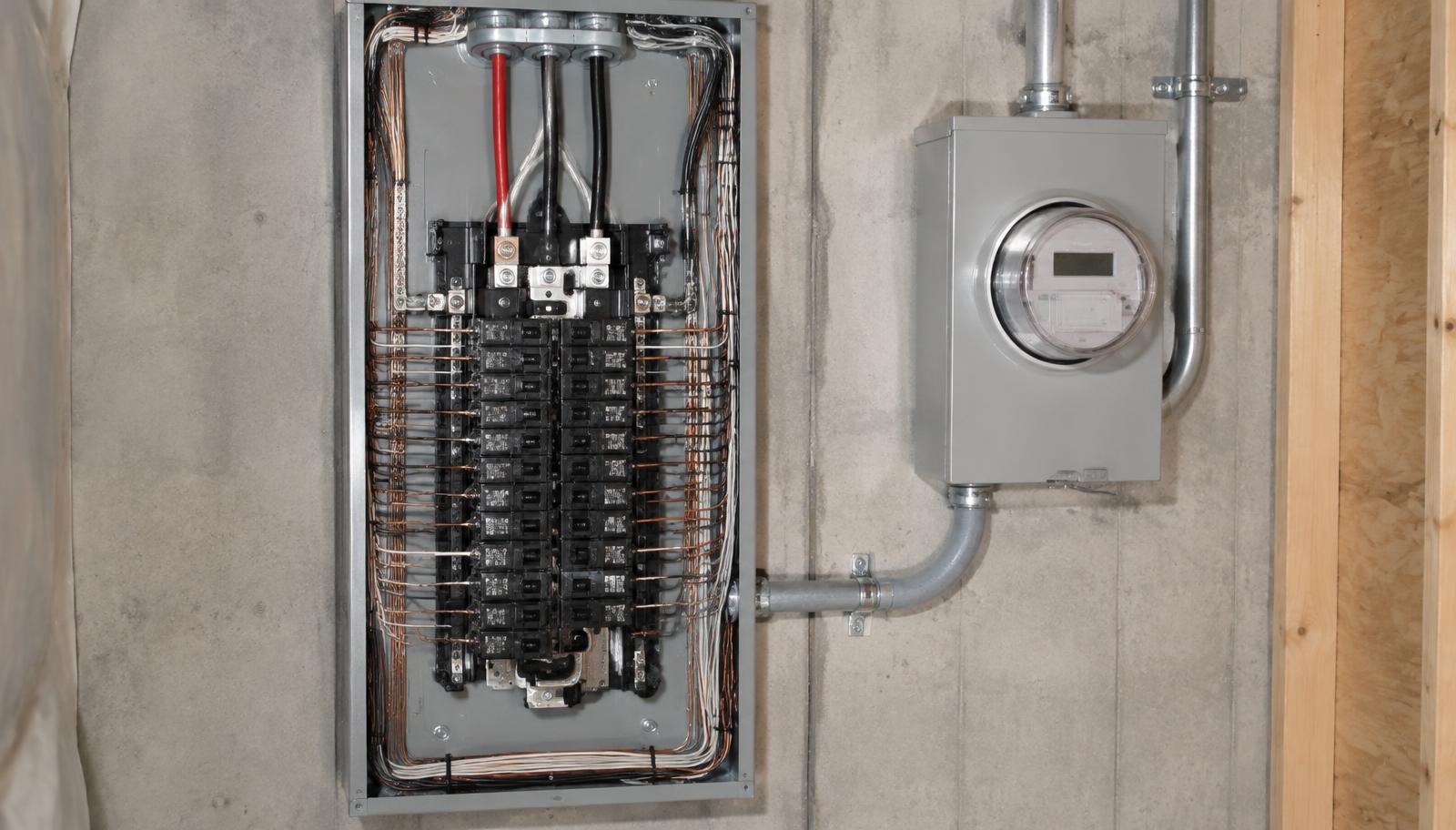
A 200 amp service upgrade replaces the meter socket, service conductors, panel, and grounding as one permitted job, with the utility coordinating the disconnect and reconnect. Cost is driven by whether the service is overhead or underground, how far the panel sits from the meter, and whether a mast, riser, or grounding electrode has to be rebuilt. Power is typically off four to eight hours.
Key takeaways
- A service upgrade is more than a panel swap. The meter socket, service conductors, main disconnect, and grounding electrode system all come up to current code with it.
- Overhead versus underground is the single biggest cost split, and a rebuilt mast or a new riser changes the number.
- Two hundred amps is the baseline for a modern New Hampshire home with a heat pump, a well pump, and an EV.
- The utility has to schedule the disconnect and reconnect, so the calendar is not entirely in the electrician's hands.
- Power is off for most of a working day. It is a one day job on nearly every house.
What a service upgrade actually includes
People say panel upgrade, but the panel is one part. A 200 amp service upgrade replaces the meter socket, the service entrance conductors, the main disconnect, the panel and its breakers, and brings the grounding and bonding up to current code.
That last part is the piece homeowners never see and inspectors always check. Older homes commonly have a single ground rod, a water pipe bond that is no longer continuous, or no bonding at all between the water and gas systems.
Everything lands as one permitted job. The town inspects it, and the utility will not reconnect the meter until that inspection clears.
| Item | What it covers |
|---|---|
| Meter socket | New socket rated for 200 amps, set where the utility can reach it |
| Service conductors | Correctly sized entrance conductors, overhead mast or underground raceway |
| Main disconnect | Service rated disconnect with the right interrupting rating |
| Panel and breakers | New panel with spare spaces, plus required arc fault and ground fault protection |
| Grounding and bonding | Ground rods, water and gas bonding, intersystem bonding termination |
| Permit and inspection | Filed with the town, inspected before utility reconnect |
| Utility coordination | Scheduled disconnect and reconnect |
Why two quotes can be far apart
The first variable is overhead or underground. An overhead service with a healthy mast in good position is the simplest case. An underground service, or an overhead one that needs a new mast, riser, and weatherhead, is more material and more labor.
The second is distance. If the panel is on the far side of a finished basement from the meter, the conductors have to get there, and that run may need a trench, a raceway, or a wall opened.
The third is what the inspector will now require that was legal decades ago: arc fault and ground fault protection on circuits that never had it, a proper grounding electrode system, and a bonded intersystem termination. Those are not upsells, they are the current code.
If your panel is a Federal Pacific Stab-Lok or a Zinsco, treat the upgrade as safety work rather than capacity work. Those breakers have a documented history of failing to trip.
Do you actually need 200 amps
The load calculation answers this, and it is run from the actual appliance list rather than the square footage. A heat pump, a heat pump water heater, an induction range, a well pump, and a level 2 EV charger add up quickly.
In practice, most Lakes Region homes still on 60 or 100 amps are at their limit before the EV charger is even discussed. If you are planning a heat pump, a generator, or a charger, the service is the first conversation, not the last.
Going above 200 amps does happen, usually on larger homes with electric heat and a shop or barn. That is a calculation, not a guess.
The day it happens
Almost every residential service upgrade is a single day. Power goes off in the morning once the utility has disconnected, and comes back the same day after the inspection clears and the meter is reset.
Plan for four to eight hours without power. Well pumps, freezers, sump pumps, and anyone working from home are the things worth arranging around in advance.
The scheduling constraint is usually the utility and the inspector, not the electrician. That is why the permit gets filed and the disconnect gets booked before a date is promised.
What the upgrade unlocks
A 200 amp service with spare panel spaces is what makes the rest of a modern house possible: a whole house generator with an automatic transfer switch, a level 2 EV charger, mini split heat pumps, a hot tub, and a finished basement or garage.
It also fixes the thing homeowners quietly live with. Breakers that trip when the microwave and the toaster run together are usually not a breaker problem, they are a capacity problem.
If a generator or a charger is anywhere in your plans, say so before the panel is picked. Leaving the right spaces and the right room for a transfer switch costs nothing on installation day and a lot later.
We work across Franklin, Tilton, Northfield, Belmont, Laconia, Concord, Sanbornton, Boscawen, plus Bristol, Center Harbor, Gilford, Loudon, Meredith, Moultonborough, and New London.